Five is a great age for cards. Most five year olds can match, count to ten and take turns, and they love beating a grown-up. Here are seven easy games for a regular deck, each with the rules in a few steps and why it works at five.
Go Fish
A standard deck, 2 or more players
- Deal seven cards each for two or three players, or five each for four or five. Spread the rest face down. That's the pond.
- On your turn, ask one player for a number you already hold: “Do you have any sevens?”
- If they have any, they hand over all of them and you ask again. If not, they say “Go fish” and you draw one card.
- Get all four of a number and lay them down. That's a book.
- When all 13 books are down, the most books wins.
Why it works at five: They have to read the numbers in their own hand and ask for what they want out loud. The asking is the fun part.
Easier at five: Lay down pairs instead of fours, and deal five cards even with two players.
Memory
A standard deck or any cards with pairs, 2 or more players
- Lay the cards face down in rows, not touching.
- On your turn, flip any two.
- If they match, keep them and flip two more. If not, turn them back over in the same spots.
- When every pair is taken, the most pairs wins.
Why it works at five: Nothing to read and nothing to add. It's matching and remembering where things are, so a grown-up doesn't get much of a head start.
Easier at five: Start with 8 to 10 pairs, not the whole deck.
War
A standard deck, 2 players
- Deal out the whole deck, 26 each, face down.
- Both flip your top card at the same time. The higher card takes both, and they go on the bottom of that player's pile.
- If the cards match, it's war. Each of you puts one card face down and one face up. The higher face-up card takes all six.
- Whoever ends up with every card wins.
Why it works at five: There are no choices to make. Every flip is just “which number is bigger,” which is good practice for comparing numbers.
Easier at five: A full game can go on a long time. Play to ten flips won, or until a timer goes off.
Snap
A standard deck, 2 or more players
- Deal all the cards face down. Nobody looks at their pile.
- Take turns flipping your top card face up onto a pile in front of you.
- When a card you flip matches the top card on someone else's face-up pile, the first to shout “Snap!” wins both piles.
- Run out of cards and you turn your face-up pile over and keep going. The goal is to win all the cards.
Why it works at five: It's matching at speed, and it's loud. Good for a kid who's done sitting still.
Easier at five: Grown-ups have to say “Snap” in a whisper.
Slapjack
A standard deck, 2 or more players
- Deal all the cards face down into neat piles. Nobody looks.
- Take turns flipping your top card face up onto one pile in the middle.
- When a jack shows up, the first hand to slap it takes the whole middle pile and adds it under their own.
- Slap a card that isn't a jack and you give one card to the person who flipped it.
- The goal is to win all the cards.
Why it works at five: There's only one card to watch for, so it works before they can hold a lot of rules in their head.
Easier at five: Grown-ups slap with the hand they don't write with.
Crazy Eights
A standard deck, 2 or more players
- Deal five cards each. Put the rest face down as the stock and turn its top card face up next to it.
- On your turn, play a card that matches the top card's number or its suit.
- An eight can go on anything. Whoever plays it says which suit comes next.
- If you can't play, draw from the stock until you can.
- The first one out of cards wins.
Why it works at five: There are only two things to check each turn, same number or same suit. If they've played UNO, it will feel familiar.
Easier at five: Call suits “shapes” and say the rule out loud every turn: same number or same shape.
Old Maid
A standard deck with one queen taken out, 2 or more players
- Take out one queen. Deal all the other cards. Hands don't have to be even.
- Everyone puts down the pairs they're holding.
- Take turns pulling one card, without looking, from the hand of the player on your right. If it makes a pair, put the pair down.
- Keep going until every card is paired except one queen. Whoever holds it is the Old Maid.
Why it works at five: The only skill is spotting pairs. The fun is keeping a straight face while you're holding the queen.
Easier at five: Hold your hand low and fanned out so small fingers can pull a card.
UNO Junior
Ages 3+ on the box, 2 to 4 players
The simple version of UNO, with 45 cards. You match the top card by color or by animal. A good bridge to the real deck.
See it on the maker's siteSpot It! Jr. Animals
Ages 4+ on the box
Match the animals on the cards before anyone else does. The box has five short mini-games, and kids get good at them fast.
See it on the maker's siteRat-a-Tat Cat
Ages 6+ on the box, 2 to 6 players
A little memory and a little math: low score wins, and you can peek, draw two or swap. At five, play it together with hands face up.
See it on the maker's siteA playing card holder
For small hands
Holding five or seven cards is the hardest part of card games at this age. A cheap card holder fixes it.
Where Pipsqueaks fits
Pipsqueaks is the card game this site makes. It's for a grown-up and a kid about 4 and up, played together on one phone or tablet. Every card is a picture and the game says the words out loud, so nobody needs to read. It's free, with no account. It won't replace a real deck at the table. It's for the nights the deck has gone missing, or you're waiting somewhere without one.
Play Pipsqueaks free → Right now the pipsqueaks are in their Halloween costumes.
If you'd rather keep the phone out of it, you can print the game at home, made for your kid: their buddy on the box, their name on every card back and a binder page for the cards they've found.
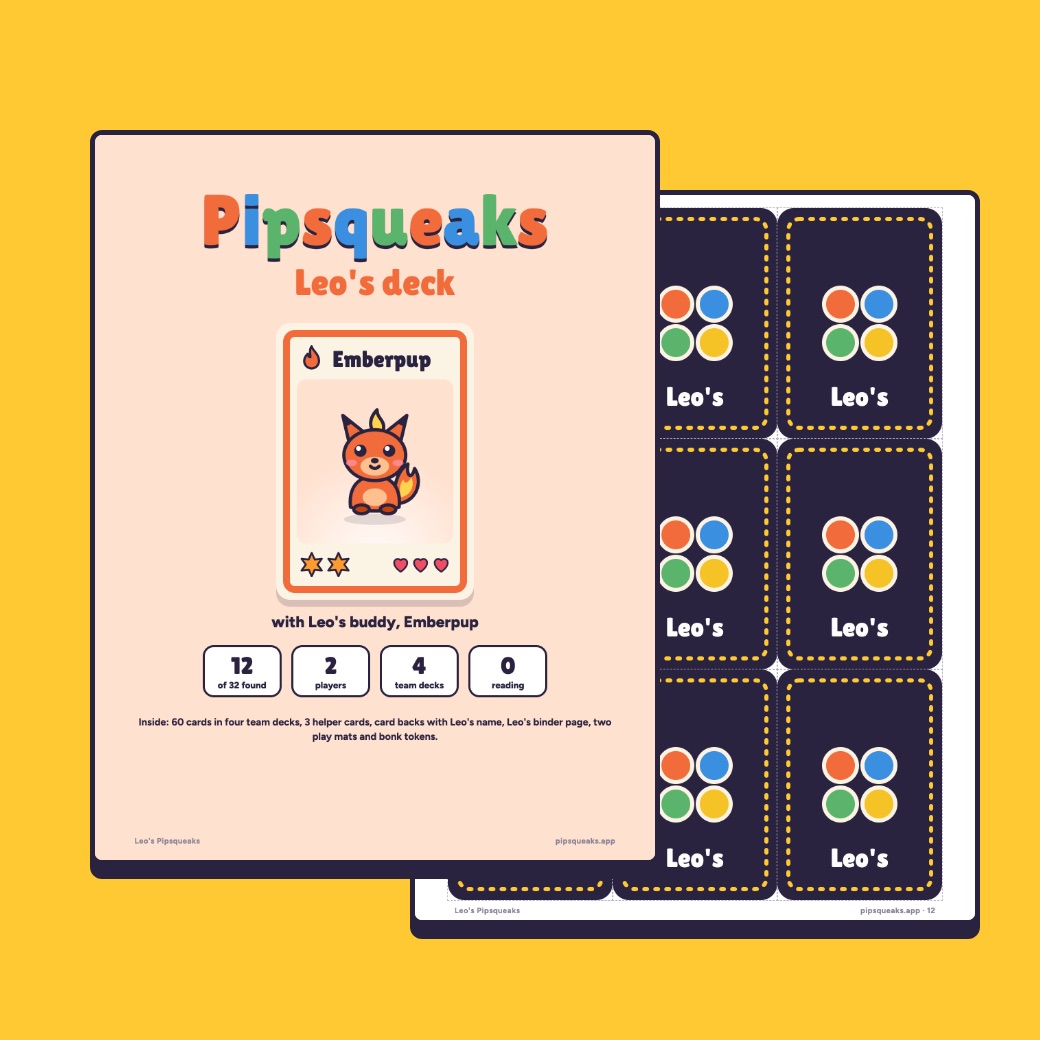
Print your kid's own deckType their name and pick their buddy to see the whole deck, free. 60 picture cards, their binder page, 2 play mats and tokens, printed at home. $4.Make their deck →
Ages for the boxed games are what each box lists. Nobody pays to be on this page.