Six is when card games get real. Many six year olds can hold a full hand and follow a rule that has an exception. Here are six games for a regular deck, each with the rules in a few steps and why it works at six.
The rules below are the standard ones. The “at six” notes are house rules, not the official ones.
Crazy Eights
A standard deck, 2 or more players
- Deal five cards each, or seven with two players. Put the rest face down as the stock and turn its top card face up next to it.
- On your turn, play a card that matches the top card's number or its suit.
- An eight can go on anything. Whoever plays it says which suit comes next.
- If you can't play, draw from the stock until you can.
- The first one out of cards wins.
Why it works at six: The eight is a rule with an exception, and choosing the next suit is a real decision. Six year olds start saving their eights for the right moment.
At six: Play the full seven-card hand with two players. UNO is built on this game, and you already own the deck.
Go Fish
A standard deck, 2 or more players
- Deal seven cards each for two or three players, or five each for four or more. Spread the rest face down. That's the pond.
- On your turn, ask one player for a number you already hold: “Do you have any sevens?”
- If they have any, they hand over all of them and you ask again. If not, they say “Go fish” and you draw one card.
- Get all four of a number and lay them down. That's a book.
- When all 13 books are down, the most books wins.
Why it works at six: At five it's a matching game. At six they start listening: if you asked for sevens two turns ago, they know where the sevens are.
At six: Play to books of four, as written. Pairs make it too quick now.
Rummy
A standard deck, 2 to 6 players
- Deal ten cards each with two players, seven each with three or four, six each with five or six. Put the rest face down as the stock and turn the top card face up to start the discard pile.
- On your turn, draw one card, from the stock or the top of the discard pile.
- Lay down any sets you have: three or four of the same number, or a run of three or more in a row in one suit, like 4, 5, 6 of hearts.
- You can also add cards to sets already on the table.
- End your turn by discarding one card. The first one with no cards left wins the hand.
Why it works at six: It's the first game where they plan ahead, holding a 5 because they're hoping for a 6.
At six: Play with hands face up for the first game and talk through what each of you is collecting.
Cheat
A standard deck, 3 or more players (also called I Doubt It)
- Deal out the whole deck. Hands don't have to be even.
- The first player puts one or more cards face down in the middle and says what they are: “Two aces.” The next player puts down twos, the next threes, and so on up to kings and back to aces.
- You can lie about what you put down. You have to put down at least one card.
- Anyone can say “Cheat!” Turn the cards over. If they were lying, they pick up the whole pile. If not, whoever called it picks it up.
- The first one out of cards wins.
Why it works at six: Counting up in order plus a straight face. Six year olds are often bad at bluffing and love it anyway.
At six: Say the number out loud for everyone each turn, so nobody loses track of what's next.
Spoons
A standard deck, spoons, 3 or more players
- Put spoons in the middle of the table, one fewer than the number of players.
- Deal four cards each. The dealer keeps the rest in a pile.
- The dealer draws a card, keeps one of their five and passes one face down to the left. Everyone does the same, passing to the left, as fast as they can.
- When someone has four of a kind, they quietly take a spoon. Then everyone grabs one.
- The player with no spoon gets a letter: S, then P, and so on. Spell SPOONS and you're out.
Why it works at six: The goal is easy to see, four the same, and the grab at the end is the part they'll ask for again.
At six: Play to a short word, like PIG, so nobody sits out for long.
Memory, the whole deck
A standard deck, 2 or more players
- Lay all 52 cards face down in rows, not touching.
- On your turn, flip any two.
- If they're the same number, keep them and flip two more. If not, turn them back over in the same spots.
- When every pair is taken, the most pairs wins.
Why it works at six: At five, ten pairs is plenty. At six, some kids can take on the whole deck, and a kid's memory can beat a grown-up's.
At six: Lay the cards in four neat rows of 13, so they can say “third row, fifth card” to remember a spot.
Rat-a-Tat Cat
Ages 6+ on the box, 2 to 6 players
A little memory and a little math: low score wins, and you can peek, draw two or swap. The box says ages 6 and up.
See it on the maker's siteA playing card holder
For a seven or ten card hand
Rummy hands are big for small hands. A cheap card holder keeps them from showing everyone.
Where Pipsqueaks fits
Pipsqueaks is the card game this site makes. It's for a grown-up and a kid about 4 and up, played together on one phone or tablet. Every card is a picture and the game says the words out loud. It's free, with no account. It won't replace a real deck at the table. It's for the nights the deck has gone missing, or you're waiting somewhere without one.
Play Pipsqueaks free →
If you'd rather keep the phone out of it, you can print the game at home, made for your kid: their buddy on the box, their name on every card back and a binder page for the cards they've found.
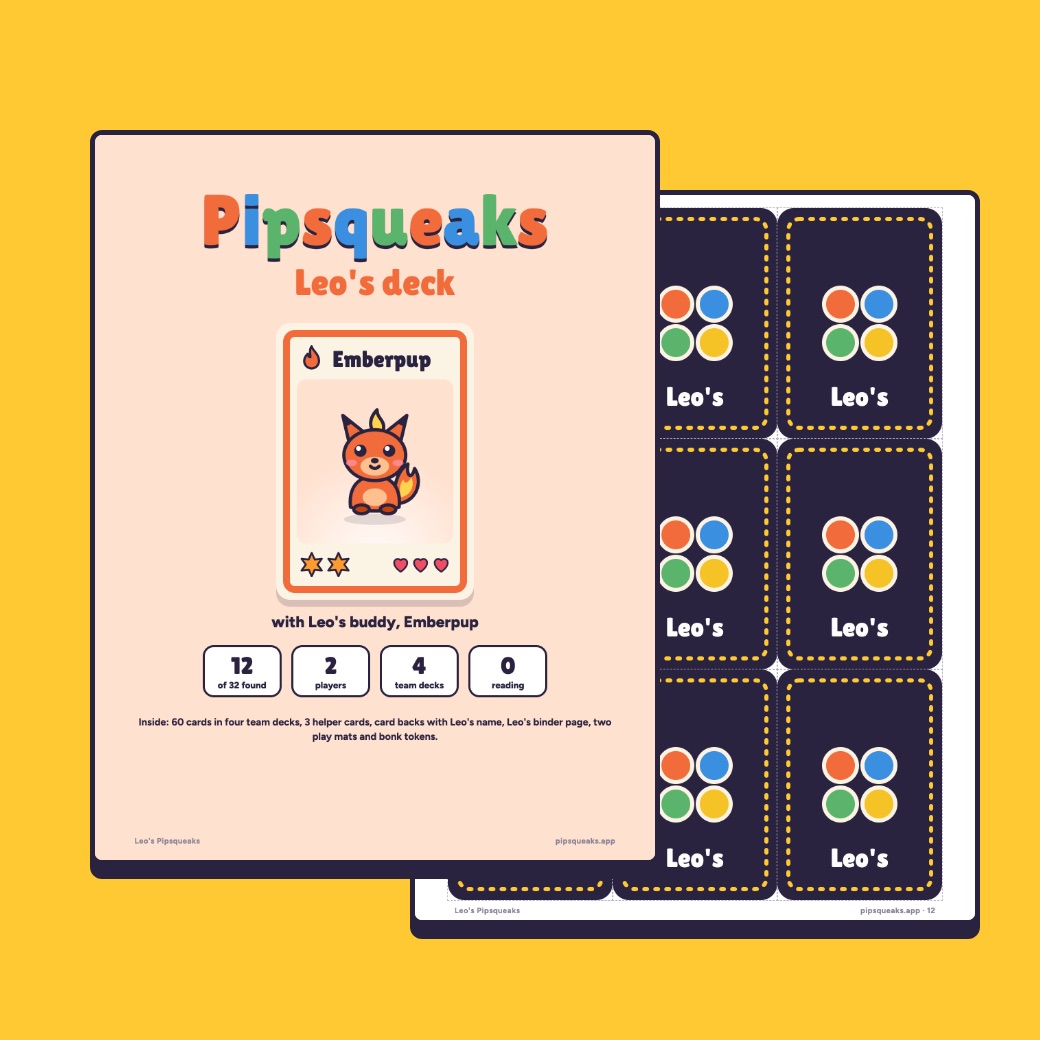
Print your kid's own deckType their name and pick their buddy to see their cover, binder page and three sample cards, free. The full deck adds all 60 picture cards, 2 play mats and tokens. It's $4, one payment, and you print it at home.Make their deck →
Ages for the boxed game are what the box lists. Nobody pays to be on this page.